
The most valuable energy asset on your property is probably the ground under your feet.
About twenty feet down, the earth in central Virginia holds a steady 55°F. In January, in August, and nearly every day in between.
That stability is a resource, and geothermal HVAC is the technology that puts it to work. It uses the ground as the exchange point for heating and cooling the building above it.
Everything else follows from that. Here is how it works, the types of systems available, and why vertical closed-loop has become the standard for most new installations.
Heat Can Be Moved Instead of Made
There are two basic ways to warm a building, and most people are familiar with only one.
The traditional way is to make heat. Burn natural gas, oil, or propane and convert that fuel into warmth. Or run electricity through a resistance coil, essentially a large toaster. Either way, energy is being consumed to produce heat.
That approach has a built-in ceiling. A perfect furnace could convert 100% of its fuel's energy into usable heat, but never more than that. Real equipment comes in somewhat below that mark.
The other approach is to move heat that already exists.
That is what a heat pump does.
Your refrigerator works on the same principle. It does not create cold. It removes heat from inside the refrigerator and releases it into your kitchen. Reach behind your fridge and you can feel that heat coming off the coil.
A heat pump uses the same basic process deliberately. In winter, it gathers heat from outside the building and moves it inside. In summer, the cycle reverses, removing heat from the building and releasing it outside.
One machine. Both seasons.
Because the electricity powers the process of moving heat rather than becoming the heat itself, a heat pump can deliver four or five units of heat for every unit of electricity it consumes.
Engineers describe this using coefficient of performance, or COP. A COP of 4.0 means the system delivers four units of heat for every unit of electricity used.
That can sound like 400% efficiency, which would be impossible if the equipment were creating energy. It is not. The heat pump is moving energy from one place to another.
Think of it as a conveyor belt. A good conveyor can move far more weight than the energy required to run the belt.
That is the advantage behind heat pump technology.
Geothermal is about giving that heat pump a better place to exchange heat.
The Question That Leads to Geothermal
If a heat pump moves heat from one place to another, the obvious question is: from where, and to where?
The most common answer is outdoor air.
An air-source heat pump, typically using equipment located beside or on top of the building, exchanges heat with the surrounding air. Millions of buildings use them, and modern systems can perform very well.
The challenge is that outdoor air becomes least favorable when heating and cooling demand is highest.
In winter, the heat pump has to extract heat from cold outdoor air. There is still heat in 20°F air, but it becomes harder to extract as temperatures fall. At the same time, the building needs more heating.
That means efficiency and heating capacity can decline on the coldest days of the year. Some systems compensate with supplemental electric resistance heat, which operates at a COP of about 1.0.
Cold, humid conditions add a second effect. When outdoor temperatures fall below roughly 40°F with moisture in the air, frost can form on the outdoor coil. The system periodically reverses to clear it, which consumes energy and briefly interrupts heating.
Summer creates the opposite problem.
Now the heat pump has to move heat out of the building and reject it into outdoor air that may already be 95°F. The hotter the surrounding air becomes, the harder the system has to work.
Central Virginia experiences both conditions. Richmond's winter design temperature sits near 19°F, while summer temperatures routinely reach the 90s with high humidity.
Illustrative example. Actual figures vary by building, equipment, utility rates, and usage.
So the question becomes:
Is there something nearby that remains at a more moderate temperature throughout the year?
The Ground Is the Answer
Yes. It is directly underneath the building.
Dig down roughly twenty feet and seasonal temperature swings become dramatically smaller.
At the surface, temperatures may vary by 60 or 70 degrees between winter and summer. Deeper underground, temperatures in central Virginia remain relatively stable, typically around 55 to 57°F.
This is not heat rising from deep inside the earth.
At these depths, ground temperature is largely influenced by the region's annual average air temperature. The enormous thermal mass of the soil and rock absorbs temperature changes at the surface and smooths them out over time.
Think of the ground as a thermal flywheel.
Connect a heat pump to that stable ground temperature instead of outdoor air and the operating conditions improve in both seasons.
In winter, the system exchanges heat with ground near 55°F instead of trying to pull heat from 19°F outdoor air.
In summer, it can reject building heat into ground near 55°F instead of 95°F outdoor air.
That temperature difference matters most when the building's heating or cooling demand is highest.
That is geothermal HVAC.
It is not a fundamentally different way of heating and cooling a building. It is heat pump technology connected to a far more stable heat source and heat sink.
Three Main Types of Geothermal Systems
To exchange heat with the ground, the system needs a way to transfer energy between the building and the earth.
There are three common approaches, and they apply whether the building is a house, a school, or an office.
Open Loop
An open-loop geothermal system pumps groundwater from a well, passes it through the geothermal system, and then returns that water to the same aquifer or an approved surface water source, subject to system design and local requirements.
Strength: Groundwater transfers heat very effectively. Where conditions are favorable, open-loop systems can be highly efficient and may require less underground infrastructure than a closed-loop borefield.
Weakness: The system depends on a groundwater source. Flow rate must be adequate and sustainable, and water chemistry can become an important operating consideration. Iron, hardness, sulfur, and other minerals may contribute to fouling or maintenance issues. Permitting requirements can also be more involved.
Where it fits: Properties with proven, clean, plentiful groundwater, from rural homes on established wells to larger buildings, where the owner is comfortable operating a water system alongside the mechanical system.
Closed Loop, Horizontal
Horizontal geothermal systems use sealed pipe installed in trenches, typically several feet below grade and spread across a relatively large area.
Strength: Trenching generally costs less per foot than drilling. On large, open sites with suitable soils and available land, horizontal loops can offer a lower-cost way to install ground heat exchange capacity.
Weakness: They require substantial land area. Because the loops are installed relatively close to the surface, they are also more exposed to seasonal ground-temperature changes than deep vertical systems. Future construction, landscaping, paving, or other site development can also become more complicated.
Where it fits: Homes on large lots, rural properties, and campuses with significant available land and limited future development planned over the loop field. Horizontal loops are most common in residential settings, where the land is often already there.
Closed Loop, Vertical
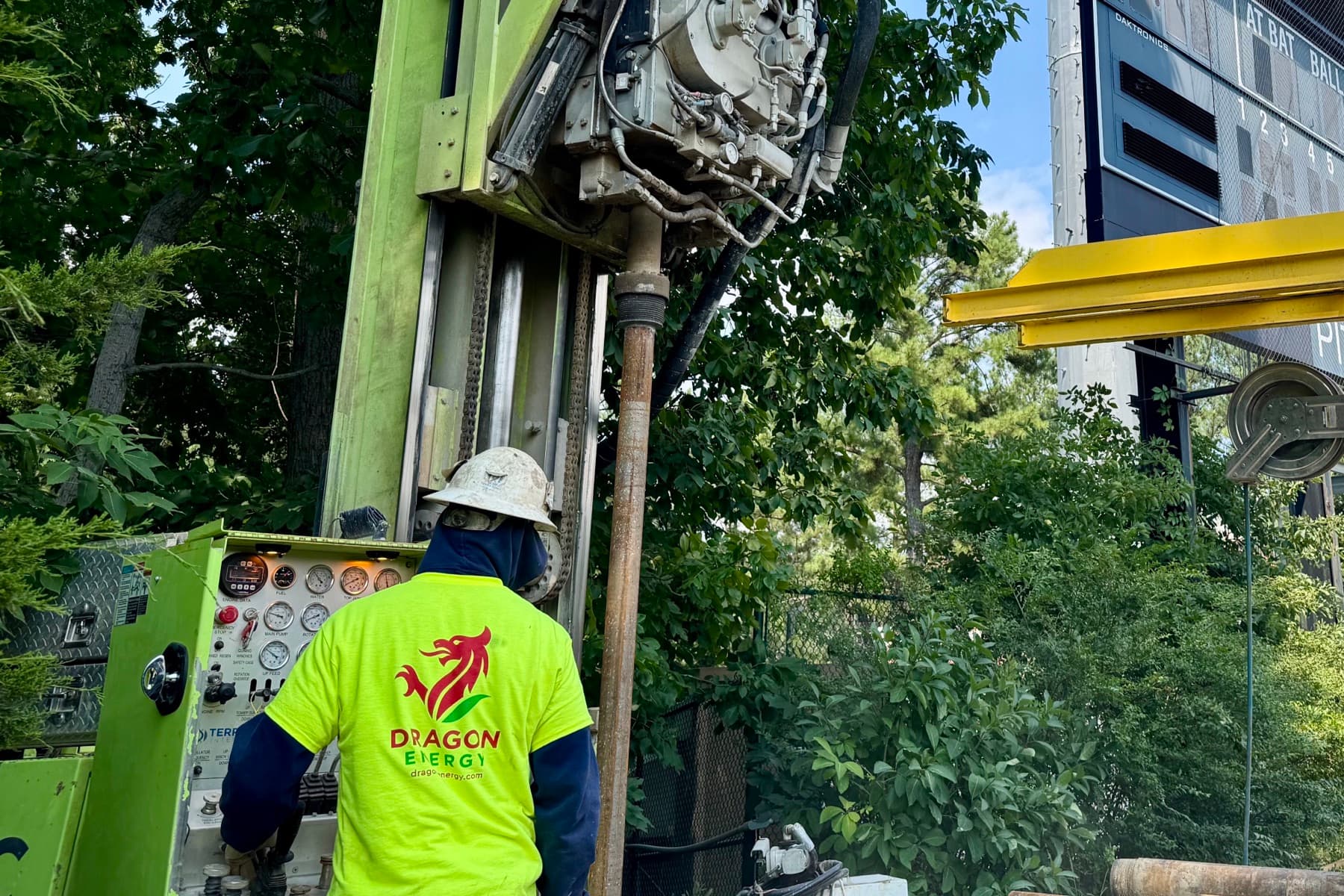
Vertical closed-loop geothermal systems use sealed U-shaped loops of high-density polyethylene pipe installed in boreholes drilled deep into the ground. The boreholes are then grouted to create good thermal contact between the pipe and the surrounding formation.
This is the most common configuration for new installations, and the reasons hold across building types.
Why Vertical Closed Loop Works So Well
Vertical closed-loop geothermal combines several advantages that hold across building types, from single homes to institutional campuses.
1. Depth Provides Greater Temperature Stability
A horizontal loop installed a few feet below grade still experiences some seasonal temperature change.
A vertical bore extends hundreds of feet into ground where those seasonal swings are far smaller. Most of the loop operates in a relatively stable thermal environment throughout the year.
That means more predictable operating conditions in both heating and cooling.
2. It Fits on Real Sites
This is often the deciding factor.
Horizontal geothermal fields can require a substantial amount of land. Vertical borefields concentrate that same heat-exchange capacity into a much smaller footprint.
Boreholes can be installed beneath driveways, yards, parking areas, courtyards, athletic fields, and other usable space.
Once construction is complete and the site is restored, the geothermal field is largely invisible.
The borefield itself requires no outdoor equipment: no condensing units, no cooling towers, nothing occupying the yard or the roof. The ground above it can generally return to normal use.
On a tight suburban lot or an urban infill site, this can be the difference between a practical geothermal project and one that simply will not fit.
3. It Is a Sealed System
A closed-loop system circulates heat-transfer fluid through fused polyethylene piping.
It does not continuously withdraw groundwater or depend on an aquifer for daily operation.
That means there is no groundwater chemistry passing through the heat pumps, no ongoing withdrawal and reinjection process, and much less dependence on changing groundwater conditions.
From an owner's perspective, the underground system is comparatively simple.
4. Performance Can Be Modeled Before Construction
Vertical borefields can be engineered around known building loads, bore depth, spacing, geology, ground temperature, and thermal properties.
Smaller systems are typically designed from regional geological data and local drilling records. Larger ones can add site-specific testing to sharpen the assumptions.
That makes it possible to model long-term borefield performance before the system is built and design the field around the building's actual heating and cooling profile.
5. The Borefield Is a Long-Term Asset
The underground portion of a geothermal system contains no compressors, fans, burners, or other major moving components.
Properly installed, fused HDPE piping carries manufacturer service life ratings exceeding 50 years.
The indoor heat pumps and other mechanical equipment will eventually be replaced, just as conventional HVAC equipment is replaced.
The borefield, however, is infrastructure.
Once it is installed, the next generation of heat pumps can often continue using the same underground system.
That changes the economics of geothermal.
A conventional HVAC replacement is primarily an equipment purchase. A geothermal project includes equipment, but it also creates a long-lived thermal asset beneath the property.
The Trade-Off, Stated Plainly
Vertical geothermal costs more upfront than many conventional HVAC systems, and drilling is a major reason why.
Drilling requires specialized equipment, experienced crews, subsurface knowledge, and careful installation. On many projects, the borefield is the single largest portion of the initial geothermal investment.
That cost is real and should not be hidden.
What the owner receives in return is an underground system designed to last for decades, stable operating conditions throughout the year, virtually no outdoor equipment, and a heat-exchange system that requires very little day-to-day attention.
It also changes the building's exposure to energy prices. A geothermal system buys no fuel at all, and it uses less total energy to deliver the same heating and cooling. Whatever energy costs do over the next twenty years, the building feels less of it.
The right question is not simply whether geothermal costs more to install.
It is what that additional investment creates over the life of the building.
What Geothermal Looks Like Inside Your Building
Once the geothermal loop is in the ground, much of the rest of the system looks familiar.
Water circulates between the borefield and heat pumps located inside the building. Those units provide heating and cooling much like conventional HVAC equipment, but the heat exchange happens with the ground instead of outdoor air.
The heat pumps themselves are generally located indoors, protected from rain, snow, direct sunlight, and extreme outdoor temperatures.
There are no outdoor condensing units required for the geothermal heat pumps and no combustion associated with heating.
That can eliminate equipment such as flues and gas-fired burners, along with the maintenance associated with them.
Depending on the building and the system design, existing ductwork or hydronic distribution may also be reusable.
Geothermal systems can be configured for individual zones, centralized systems, or combinations of both, depending on the needs of the building.
From the occupant's perspective, there is very little about the system that feels unusual.
The building is simply heated and cooled.
The difference shows up in two places: where the heat comes from, and what it costs to move it.
The Short Version
Burning fuel creates heat.
A heat pump moves heat.
Because it moves energy instead of making it, a heat pump can deliver four or five units of heating for every unit of electricity it uses.
Air-source heat pumps trade that energy with outdoor air, which turns against them in the seasonal extremes.
Geothermal heat pumps trade it with the ground which stays relatively consistent year round.
Vertical closed-loop is the most practical way to make that connection on almost any site: stable conditions, a compact footprint, a sealed system, and infrastructure built to last decades.
Where to Go Next
The fastest way to find out whether geothermal makes sense for your property is to ask someone to look at it.
Request a free geothermal assessment. We will review your site, your building, and what you currently spend on heating and cooling, then tell you honestly whether geothermal is a good fit, including when it is not.
You can also review our geothermal incentives overview for what is currently available in Virginia.